Pronto Stimulants CPDD 2026 Poster
This poster was presented at College on Problems of Drug Dependence (CPDD) Conference in June of 2026 by Scott W. Formica, PhD from Social Science Research and Evaluation, Inc.(SSRE). The findings highlighted in this poster were collected as part of the PRONTO Stimulants Study.
Title: “We Were Focused so Long on Opioids that Stimulants Have Always Been Under the Rug”: Adapting Post-Overdose
Outreach for Cocaine and Methamphetamine-Involved Events
Conference Abstract
Authors: Scott W. Formica, Justeen Hyde, Ally Cogan, Moriah Wiggins, Andrew Rolles, Sarah Kosakowski, Stephen Murray, Jiayi Wang, Mackenzie C. Gamble, Danielle F. Haley, Corinne Beaugard, Ziming Xuan, Alexander Y. Walley, Sarah M. Bagley
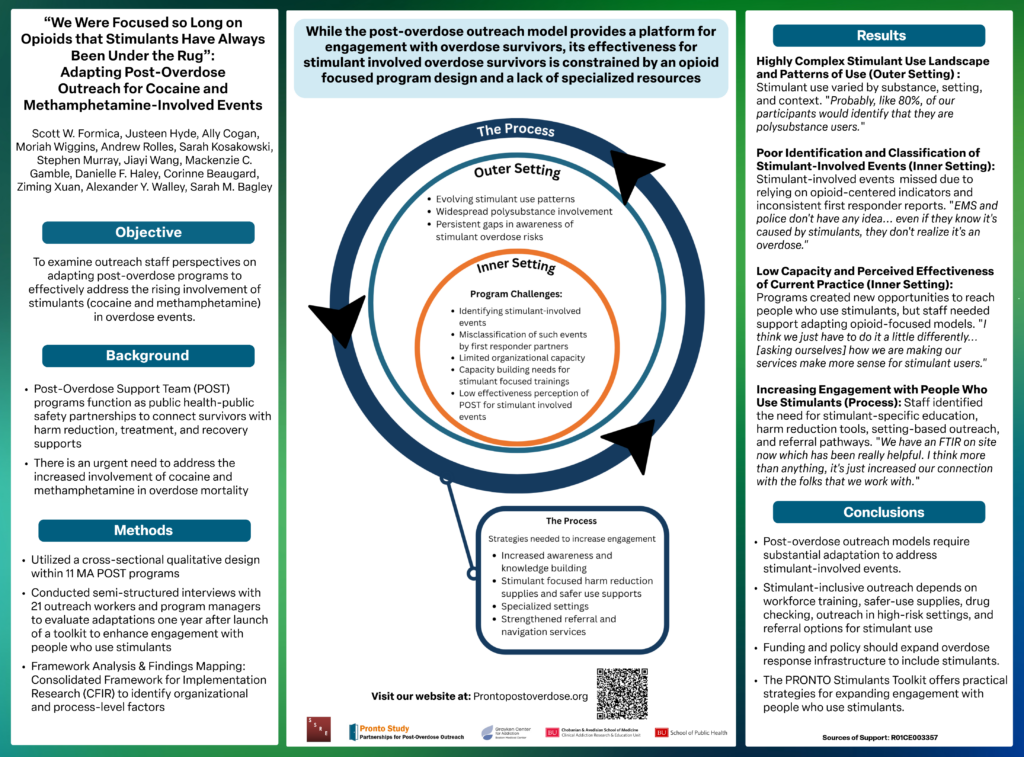
Aims: Post-overdose outreach programs have expanded in the United States to connect individuals who survive an overdose with harm reduction, treatment, and recovery supports. Despite increased involvement of stimulants (e.g. cocaine and methamphetamine) in overdose morbidity and mortality, these programs have focused almost exclusively on opioid overdose events. This qualitative study examines outreach staff perspectives on how such programs might adapt to better address stimulant-involved overdose.
Methods:Semi-structured interviews were conducted with 21 staff across 11 Massachusetts post-overdose outreach programs. Transcripts were deductively and inductively coded using framework analysis and organized using the Consolidated Framework for Implementation Research.
Results: Multi-level factors shaped adaptations. In the outer setting, staff highlighted evolving stimulant use patterns, widespread polysubstance involvement, and persistent gaps in awareness of stimulant overdose risks. Within the inner setting, programs faced challenges identifying stimulant-involved events, misclassification of such events by first responder partners, and limited organizational capacity. Staff noted that while post-overdose outreach created new opportunities to engage people using stimulants, effectiveness remained constrained by opioid-rooted program design. Staff identified the need for training, resources, and stronger referral networks. In the process domain, staff described engagement strategies considered essential for broadening outreach to include people who use stimulants.
Conclusions: Post-overdose outreach programs, historically focused on opioid-involved overdose, may be ill equipped to address stimulant-involved overdose. This study points to the need for substantial program adaptations, workforce development, and strengthened referral pathways along with sustained investment in harm reduction infrastructure and policy guidance acknowledging stimulant-involved overdose as a component of the overdose crisis.