Pronto Stimulants CPDD 2026 Poster
This poster was presented at College on Problems of Drug Dependence (CPDD) Conference in June of 2026 by Sarah M. Bagley, MD, MSc from Boston Medical Center. The findings highlighted in this poster were collected as part of the PRONTO Stimulants Study.
Title: Barriers and facilitators to implementation of cocaine and methamphetamine-specific post-overdose services among post-overdose programs in Massachusetts: an explanatory sequential mixed methods approach
Conference Abstract
Authors: Danielle F. Haley, Scott W. Formica, Justeen Hyde, Moriah Wiggins, Ally Cogan, Jiayi Wang, Andrew Rolles, Sarah Kosakowski, Stephen Murray, Mackenzie C. Gamble, Corinne A. Beaugard, Ziming Xuan, Alexander Y. Walley, Sarah M. Bagley
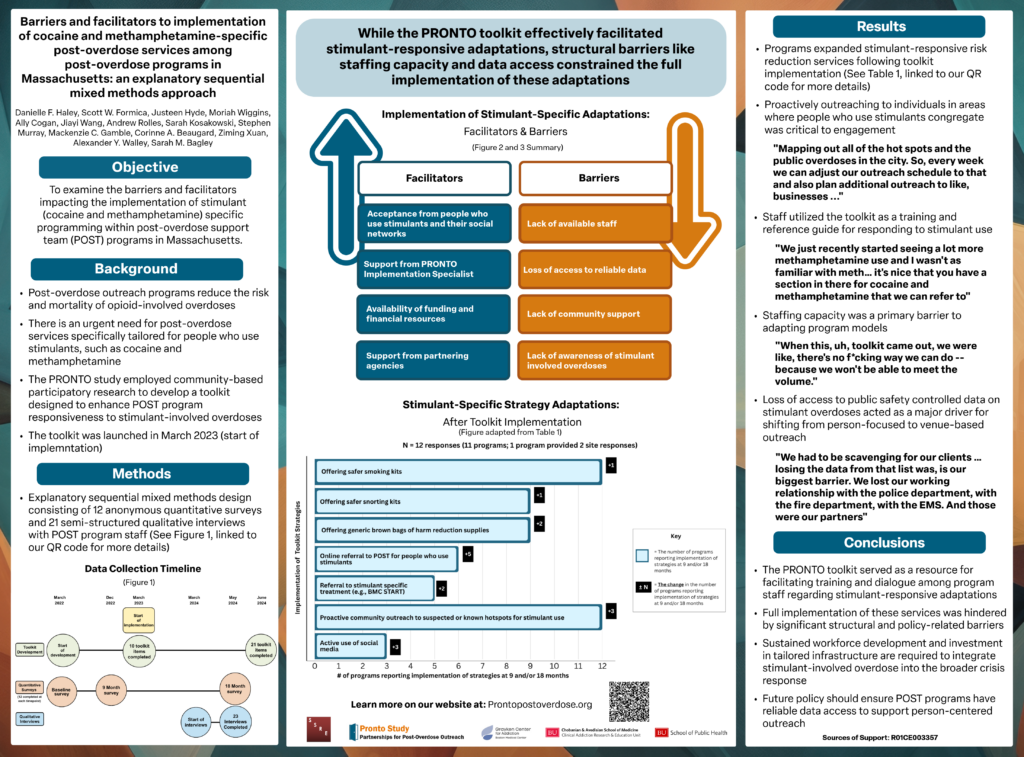
Aims: Post-overdose outreach programs reduce the risk and severity of opioid overdose. Post-overdose services for people who use stimulants (cocaine and methamphetamine) are urgently needed. We examined barriers and facilitators to implementation of stimulant-specific programming among post-overdose support team (POST) programs in Massachusetts (MA).
Methods: The PRONTO study used a community-based participatory research approach to develop and implement a toolkit to enhance responsiveness of POST programs in MA to stimulant-involved overdose. This explanatory sequential mixed methods study used quantitative surveys collected pre- and 9- and 18-months post-implementation from 12 POST programs and 21 semi-structured qualitative interviews collected from POST staff 12-months post-implementation to examine barriers and facilitators to stimulant-specific post-overdose programming.
Results: All 12 POST programs expanded: 1) risk reduction services for people using stimulants (e.g., safer smoking kits), 2) stimulant responsive trainings to partners and community stakeholders (e.g., vein/wound care), 3) venue-based outreach and education (e.g., hotels/motels). The combination of approaches varied. In surveys, staffing capacity was the top barrier to adapting programming; training opportunities and support from people using stimulants and their networks were top facilitators. In qualitative interviews, POST staff described the toolkit as a resource for facilitating training and dialogue among POST providers. Lack of stimulant-specific services was a barrier to referrals. Dependence on public safety institutions for data on stimulant overdose events, and loss of access to data, was a major barrier to person-focused outreach and driver of expanded venue-based outreach. Having staff who were able to build relationships and conduct proactive outreach to places where people who use cocaine and methamphetamine may congregate was foundational to relationship-building.
Conclusions: The toolkit facilitated stimulant-responsive post-overdose outreach adaptations. Structural barriers prevented full implementation. There is a need for sustained workforce development, investment in tailored infrastructure and policy guidance integrating stimulant-involved overdose in the overdose crisis response.